Text
Text
SengA Classic Stage Company
Phone: Email:
(805) 646-4885 franciscabeach@gmail.com

Ventura County Star - Venture Out – Sept. 20th 2013
The Farce is with Them!
Senga troupe has a wild time with Oscar Wilde classic
Review by Rita Moran - Arts Writer
Clever, well-rendered. farce leave audiences thinking and laughing in equal measure Senga Classic Stage Company's presentation of Oscar Wilde's "The Importance of Being Earnest" hits that mark. One of the enduring gems from the Victorian Age, it alighted on the London stage in 1895, sealing Wilde's reputation as a farceur of the highest order.
The playwright's droll and on-the-mark wit prods and pokes at class-bound starchiness while simultaneously mocking assumptions about what passes for proper behavior among the elite. Senga's cast, under the spirited direction of troupe founder Francesca Beach hits the mark in all the important elements.
A particularly strong cast holds forth, with Wilde's verbal jabs coming across loud and clear no matter where the players find themselves. No line is lost, even as the actors move from stage to a central space in the theater, from proscenium-bound action to free-flowing expression on the floor. There are even waves of appropriate music, including a particularly funny blast of "Ah, Sweet Mystery of Life at Last I've Found Thee" when a couple declares endless love. The song's composer Victor Herbert actually was a contemporary of Wilde's but was more into operetta than satire.
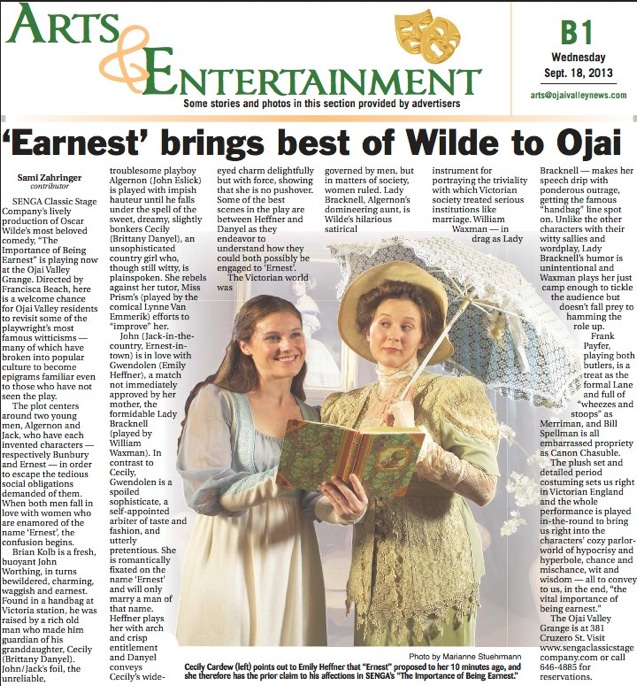
The leading characters get engaging, and often very funny, performances from the actors, beginning with Brian Kolb as John Worthing and John Eslick as his pot-stirring friend, Algernon Moncrieff. They meet their matches in the two women who fall for "Ernest"
Worthing, who has either just perished, gone on an extended holiday or been whisked away to prison for his cheeky behavior. Gwendolen Fairfax (Emily Heffner) arrives to visit Algernon at his London flat and finds him in a cheery mood, despite the fact that she comes with her imposing mother, Lady Bracknell (William Waxman). Algy’s friend John Worthing has been keeping his country life in Hertfordshire hidden from the London crowd. Back in the country he is guardian to a young woman, Cecily Cardew (Brittany Danyel). Algernon has his own way of taking leave from town, going to visit a fictitious friend by the name of Bunbury. When he learns John's secret, he accuses him of Bunburyism, assuring him that all men need a Bunbury to get out of social events or away from people who might bore them.
The comings and goings, protestations and recriminations, all work through an amusing set of interrelations that ultimately make everything fall in place. But first, there are the misunderstandings, declarations and regrets aplenty.
Kolb, recently seen in Santa Barbara as a young Spinoza at the height of his expansive discoveries in "New Jerusalem," brings a good deal of that same vitality and underlying seriousness that makes his John (also called Jack when he's not trying to be Ernest) a forceful presence. Eslick, as the much more casual Algernon, is a living, breathing good old boy, dallying, lazing about and eating cucumber sandwiches. Until he meets Cecily, of course.
The two young women carve out opposites, Gwendolen, the town woman and Cecily the country girl, until they find instant bonding in their similar plights. Heffner’s Gwendolen can switch from haughty to boldly conniving at the drop of a hatpin. Danyel's Cecily is an open book awaiting life; in the interim she keeps a detailed diary and allows her fancies to run free. Both are well suited to their roles, playing up the contrasts in highly entertaining style.
Of particular note - for those who have seen formidable women play Lady Bracknell - is the equally formidable (and almost believable) work by William Waxman in the role.
Supporting roles are also deftly played, with Lynn Van Emmerik embodying the tutor Miss Prism with understated spinster charm; Frank Payfer as both butlers, the upright Lane in London and the bent-over and red-faced Merriman in the country; and Bill Spellman as the fluttery Canon Chasuble trying his best to handle two christenings for grown men who both want to be named ‘Ernest’.
This "Earnest" brings out all the best in Wilde's style, with no sly bit of wit slipping by in the very well spoken and well-delivered efforts of all involved.